
— Our core service
Epoxy Garage Floor Coating in Austin, TX
Diamond-ground prep, full flake broadcast, and a clear polyaspartic topcoat that survives a Texas summer. Most 2-car garages finished in a single day.
1 Day
Most installs
15-yr
Written warranty
$1,400+
Typical 2-car garage
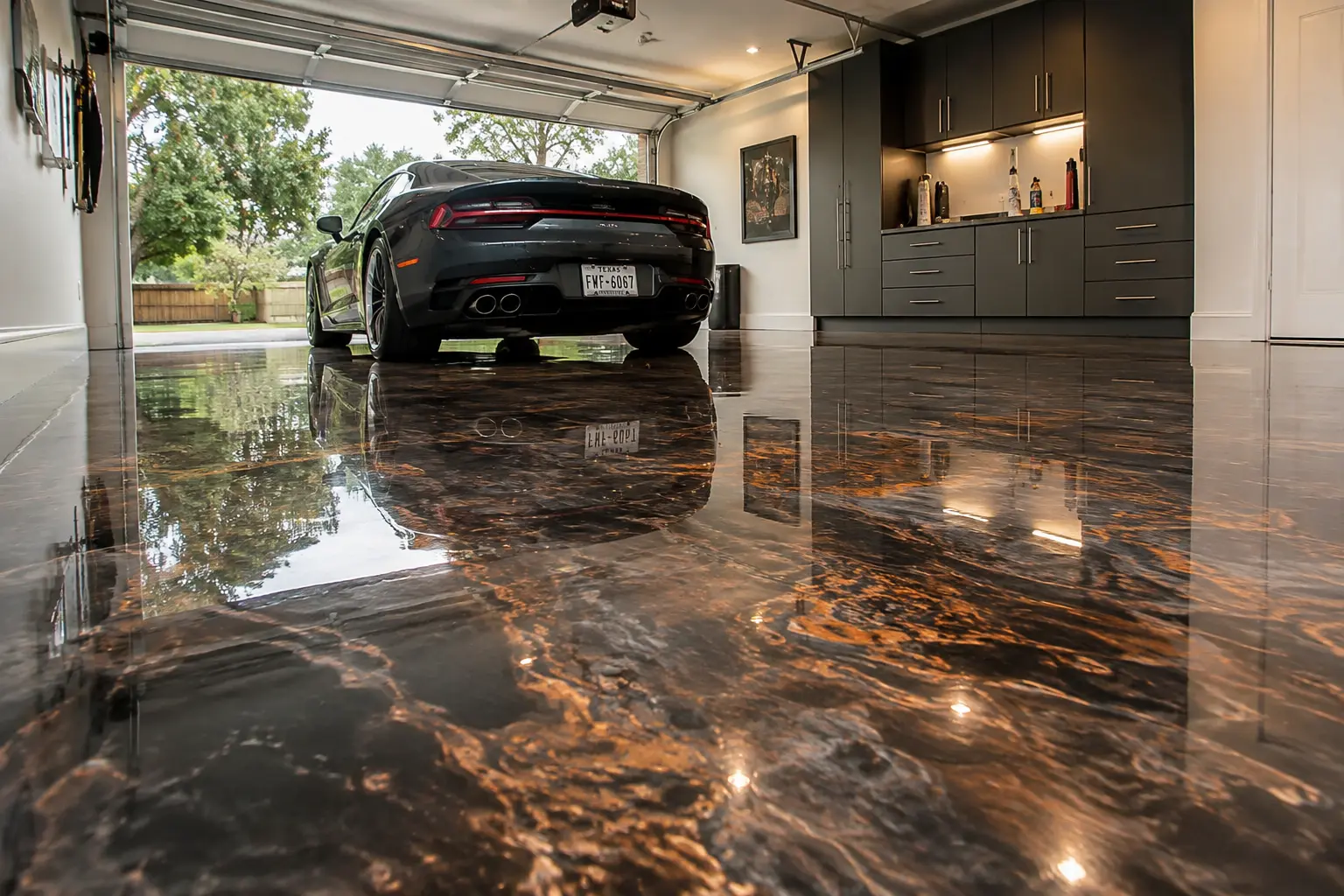
We install epoxy garage floor coating austin across Austin and the surrounding metro. Every floor starts with diamond grinding, not an acid wash, because that mechanical profile is the only thing that makes a coating actually stick. Then we fix the cracks, test for moisture, lay the base coat, broadcast flake, and seal the whole thing under a clear polyaspartic topcoat. Most 2-car garages are done in one day, cost between $1,400 and $6,000, and come with a 15-year written warranty.
If you’ve been putting this off because your slab is stained, dusty, cracked, or you already tried a big-box kit that let go after a summer, that’s normal. Most of the floors we redo are exactly that.
What you actually get
A garage floor coating is not paint. What we put down is a layered system, and each layer has a job.
End result is a floor you can sweep instead of scrub, that doesn’t dust every time you pull the car in, and that doesn’t turn yellow the first summer.
Which coating system should you pick?
Four options, and honestly, most people land on the same one. Here’s how they compare.
|
Select |
Cost |
Lifespan |
Hides dirt |
Best for |
|
Solid color |
$ |
5 to 10 yrs |
Low |
Tight budgets, storage garages |
|
Full flake |
$$ |
10 to 15 yrs |
High |
Most Austin homeowners |
|
Metallic |
$$$ |
10 to 15 yrs |
Medium |
Show garages, entryways |
|
Polyaspartic |
$$$ |
15 to 20 yrs |
Medium |
Hot, sun-exposed garages |
Full flake is what we install most, and it’s usually the right call. It hides dust and tire marks better than anything else; the chips add grip, and you can pick a blend that suits the house.
Solid color is the budget option. It looks clean on day one but shows every scuff, so it makes more sense in a storage garage than a working one.
Metallic is the showpiece. Pigments get swirled into the resin so it reads like poured marble, and no two floors come out the same. It costs more, and it’s more work, but for a garage you actually show people, it’s hard to beat.
Polyaspartic is less a look and more a performance upgrade. We use it as the topcoat on nearly every job because of the Texas sun, but you can go full polyaspartic if the garage bakes all afternoon. More on that in our epoxy vs polyaspartic breakdown.
How we install it
This is where the money actually goes, and it’s the part cheap quotes skip.

Grind the slab
We run planetary diamond grinders with vacuums attached, so your garage doesn’t fill with dust. Grinding strips off the weak surface layer, called laitance, and opens the concrete to roughly a CSP 2 to 3 profile, which feels like medium-grit sandpaper. This is the single biggest reason coatings fail or hold. Acid etching does not create this profile, and we don’t use it.

Repair and moisture test
Cracks get filled with flexible polyurea joint filler so they can move with the slab instead of telegraphing through. Deeper spalls and pits get epoxy mortar. Then we moisture-test, because if vapor is pushing up through your slab, any coating will blow off from underneath within weeks.

Base coat
A 100% solids epoxy primer and base coat goes down and soaks into the profile. Not a one-part epoxy paint, which is really just a fortified acrylic and won’t hold up to a working garage.

Broadcast flake
While the base is still wet, we broadcast vinyl chips across the entire floor to refusal, which for a full-flake look is around three-quarters of a pound per 100 square feet. Once it cures, we scrape and vacuum the loose flake back off.

Topcoat
A clear polyaspartic topcoat seals everything in. If you want extra grip, we can broadcast aluminum oxide into it, which looks like fine salt and adds real traction without making the floor feel rough.
Most residential garages finish in a day. You can walk on it that evening and park on it the next morning.
— Straight pricing
Epoxy Garage Floor Coating Austin Pricing
$1,400–$6,000
That’s the typical installed range for a 2-car garage. We put pricing on the page because you’re going to ask anyway, and because the companies that hide it usually do that for a reason.
1-car garage
240 to 300 sq ft
$900 to $2,800
2-car garage
400 to 500 sq ft
$1,400 to $6,000
3-car garage
600 to 750 sq ft
$2,400 to $8,500
Where you land comes down to which system you pick, how much crack and pit repair the slab needs, whether an old coating has to come off first, and whether moisture testing turns up a problem. A big-box DIY kit runs $400 to $700 and typically lasts one to three years. A professionally ground and coated floor costs goes10 to 20 years.
— Local know-how
Why Austin garages are hard on coatings
We work in this climate every day, and there are four things here that wreck floors faster than they would in a milder climate.

Heat
A closed garage in July can top 120 degrees. Cheap epoxy softens, and when you pull a hot car in, the tires lift the coating. That’s hot tire pickup, and it’s the number one failure we get called out to fix.

UV
Sunlight through an open door yellows standard epoxy within a season. A UV-stable polyaspartic topcoat holds its color, which is why we put one on almost every floor.

Clay soil
Central Texas sits on expansive black gumbo clay that swells and shrinks with our drought and downpour swings. It cracks slabs across Travis, Williamson, and Hays counties, so we use flexible fillers.

Humidity
Moisture vapor moving up through concrete will delaminate a coating from below. Bigger deal on newer slabs out in Leander, Georgetown, Buda, and Kyle. We test before we open a bucket.
— Where we work
Austin and the metro around it
From the Hill Country on the west side out to the eastern suburbs near the Tesla plant in Del Valle.
Neighborhoods: South and North Austin, East Austin, Circle C Ranch, Mueller, Westlake, Tarrytown, Hyde Park, Barton Hills, Steiner Ranch and Avery Ranch.
Zip codes include: 78704, 78745, 78748, 78749, 78759, 78717, 78660, 78681, 78613, 78641, 78626, 78620, 78738, 78610, and 78640.
— Good to know
Questions we get asked a lot
How long does an epoxy garage floor last in Austin?
Ten to twenty years if it’s prepped and installed properly. Ours carry a 15-year written warranty against peeling and lifting. What kills a floor early is almost never the product; it’s skipped prep.
Can you coat over my existing epoxy floor?
Usually, but not always. If the old coating is still bonded well, we can grind it and go over the top. If it’s already lifting or it’s a thin DIY kit, it all has to come off first, which adds to the cost. We’ll tell you which one you’re looking at when we come out.
Will it get hot tire pickup?
Not with a proper system. Hot tire pickup happens when a coating softens in heat or never bonded well to begin with. Diamond-ground prep plus a heat-rated polyaspartic topcoat is what prevents it, and that’s what we install.
Is the floor slippery?
Only if you want a glass finish with nothing in it. The flake itself adds texture, and we can broadcast aluminum oxide into the topcoat for extra grip. Like any hard floor, it’s still slick when there’s standing water on it.
How much of a mess is the grinding?
Less than you’d think. Our grinders run with vacuum dust collection attached, so it’s not the cloud of concrete dust people picture. We also mask off the walls and anything nearby.
Do I need to empty the garage?
Yes, completely, before we start. We need the whole slab clear to grind and coat it in one pass. Move vehicles out too, since you won’t be parking on it until the next day.
What about the control joints in my slab?
We’ll talk it through with you. Some people want them filled for a seamless look that’s easier to sweep; others want them left so the slab can move naturally. Both are valid; it just depends on the floor.
Do you do commercial floors too?
Yes. Shops, warehouses, showrooms, and restaurant kitchens. Those use chemical- and abrasion-resistant systems, and we schedule around your hours so you’re not shut down.
— Where we work
Still deciding?
PRICING
Epoxy garage floor cost in Austin
Full breakdown by garage size and finish, plus what pushes a quote up or down.
COMPARISON
Epoxy vs polyaspartic
Cost, lifespan, UV resistance, cure time, and which one suits the Texas climate.
OPTIONS
Garage flooring options in Austin
Coatings, tile, and mats compared, so you can see where epoxy actually fits.
— Ready when you are
Get a free estimate on your garage
Tell us the size of the garage and roughly what shape the slab is in, and we’ll come out, measure, check moisture, and put a firm itemized number in writing.