
— Our core service
Polyaspartic Coating in Austin, TX
Polyaspartic is the coating we reach for when a floor has to deal with real Texas heat and sun. It stays flexible, holds its color under UV instead of yellowing, and cures fast enough that most garages are back in service in a single day.
$5–15
Per sq ft installed
One Day
Install, start to park
15–20 Yrs
With proper prep
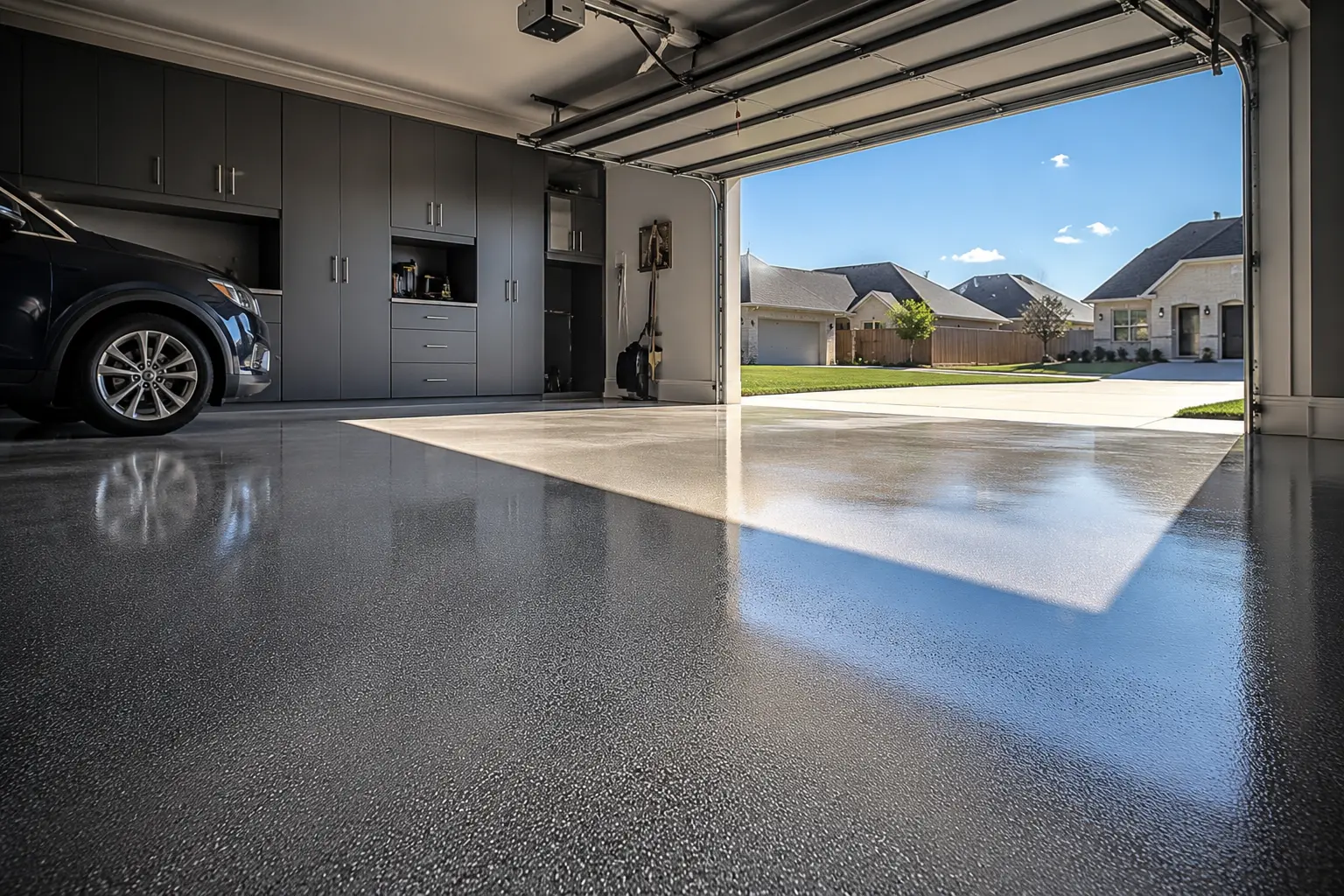
Polyaspartic is a polyurea-based system that stays flexible, holds its color under UV instead of yellowing, and cures fast enough that most garages are finished and back in service in a single day. We install it as a full system or, more often, as the clear topcoat over an epoxy or flake base. If a previous floor in your garage softened, lifted at the tire tracks, or went yellow after a summer, this is the fix.
Why Polyaspartic Coating Austin Homes Need
This isn’t marketing. There are four things about coating a floor here that push us toward polyaspartic, and they’re all climate.
Heat tolerance
A closed Austin garage in July can top 120 degrees. Standard epoxy starts softening in that range, and softened coating plus hot tires equals hot tire pickup. Polyaspartic holds up at temperatures that make cheap epoxy let go.
UV stability
Sun coming through an open door ambers standard epoxy within a season, especially light greys and whites. Polyaspartic is aliphatic, which in plain terms means it doesn’t yellow in sunlight.
Flex
Our slabs move, because Central Texas clay swells and shrinks with every drought and downpour cycle. A rigid coating cracks with the slab. Polyaspartic has enough give to move with it.
Speed
It cures in hours instead of days, which matters in summer when leaving a garage open overnight isn’t practical.
What one-day actually means
A lot of companies advertise a one-day floor and what they mean is a thin coating over an underprepped slab. Here’s our actual timeline for a standard 2-car garage.

Morning — grind and test
Grind the slab, repair cracks and pits, moisture test.

Midday — base coat
Base coat down, flake broadcast to refusal if you’ve chosen flake.

Afternoon — topcoat
Scrape and vacuum loose flake, polyaspartic clear topcoat.

That evening — walk on it
Foot traffic is fine the same evening.

Next morning — park on it
Cure is far enough along to drive the cars back in.
The prep does not get shortened to make the day work. Fast cure is a property of the material, not a reason to skip grinding. If a quote promises one day and doesn’t mention grinding at all, that’s the part being cut.
Full polyaspartic or polyaspartic topcoat?
Two ways to use it, and most Austin homes only need one of them.
|
Select |
Topcoat over epoxy |
Full polyaspartic |
|
What it is |
Epoxy base, polyaspartic clear on top |
Base and topcoat both polyaspartic |
|
Cost |
Lower |
Higher |
|
Cure speed |
Fast |
Even faster |
|
Best for |
Most Austin garages |
Full sun, commercial, extreme swings |
Epoxy base for body and adhesion, polyaspartic clear on top for UV, heat and abrasion — that’s what we install on most floors. You get the performance where it matters at a lower cost than going full polyaspartic. A full system costs more but cures even faster, and makes sense for garages in full afternoon sun, commercial floors that can’t be shut down, or anywhere temperature swings are extreme.
Wondering how it stacks up against plain epoxy across cost, lifespan and cure time? We break that down in our epoxy vs polyaspartic comparison.
Why cheap metallic jobs go wrong
Worth knowing before you compare quotes. Flake is fairly forgiving. Metallic is not.
— Straight pricing
What it costs in Austin
$5 to $15 per sq ft
Polyaspartic coating Austin pricing sits above standard epoxy, roughly $5 to $15 per square foot installed depending on whether you’re doing a topcoat over epoxy or a full system, and what shape the slab is in. The honest way to think about it: the topcoat upgrade is a small part of the total job cost, and it’s the layer doing most of the work against our climate. It’s rarely where we’d suggest saving money.
Topcoat over epoxy
Standard 2-car garage
$2,000 to $7,000
Full polyaspartic system
Full sun / commercial floors
Runs higher; quoted on site
Full breakdown by size and finish in our Austin epoxy garage floor cost guide →
— Where full system makes sense
When to go full polyaspartic instead of a topcoat
Most Austin homes only need a topcoat. These are the situations where the full system earns its higher cost.

Full afternoon sun
Garages with no shade and hours of direct exposure, where UV load is highest.

Commercial floors
Spaces that can’t be shut down for days, where the faster full-system cure matters.

Extreme temperature swings
Anywhere thermal cycling is severe, and a rigid or partial system would be pushed hardest.

Previously failed epoxy
A floor that already softened, lifted at the tire tracks, or yellowed and needs a real fix.
— Where we work
Austin and the metro around it
From the Hill Country on the west side out to the eastern suburbs near the Tesla plant in Del Valle.
Neighborhoods: South and North Austin, East Austin, Circle C Ranch, Mueller, Westlake, Tarrytown, Hyde Park, Barton Hills, Steiner Ranch and Avery Ranch.
Zip codes include: 78704, 78745, 78748, 78749, 78759, 78717, 78660, 78681, 78613, 78641, 78626, 78620, 78738, 78610, and 78640.
— Good to know
Common questions
Is polyaspartic better than epoxy?
For a hot, sunny Austin garage, generally yes. It handles heat and UV better and cures faster. Epoxy is cheaper and builds a thicker body, which is why the two are usually used together, epoxy underneath and polyaspartic on top.
Can polyaspartic go over my existing epoxy floor?
Often yes, if the existing coating is still bonded well. We’d grind it to profile the surface first. If the old floor is already lifting or it’s a thin DIY kit, it needs to come off completely, and we’ll tell you which one you have when we look at it.
Does it really cure in one day?
Yes, that part is real. Polyaspartic has a much shorter cure window than epoxy. Foot traffic the same evening, vehicles the next morning is normal. What it also means is a short pot life during install, which is exactly why this is a poor DIY material.
Will it yellow in the sun?
No, and that’s the main reason we use it. Polyaspartic is aliphatic, so it holds its color under UV. Standard epoxy is not, which is why so many Austin garages with sun exposure go amber within a year or two.
Is it slippery?
Not if it’s finished properly. Flake adds texture on its own, and we can broadcast aluminum oxide into the clear coat for extra grip. Like any hard floor, it’s slick with standing water on it.
How long does a polyaspartic floor last?
Fifteen to twenty years with proper prep. Ours carries a 15-year written warranty against peeling and lifting. It generally outlasts a straight epoxy floor in this climate, mostly because of the heat and UV resistance.
— Keep reading
Still deciding?
CORE SERVICE
Epoxy garage floor coating
The full flake system we install most, and how polyaspartic fits on top of it.
COMPARISON
Epoxy vs polyaspartic
Cost, lifespan, and cure time compared side by side, so you know which fits your garage.
PRICING
Austin epoxy garage floor cost guide
Full breakdown by size and finish, plus what pushes a quote up or down.
— Get a floor built for the heat
Get a free on-site estimate
Tell us about the garage, how much sun it gets, and what shape the slab is in. We’ll come measure, moisture test, and give you a firm written number, with no pressure attached.