
— Commercial & industrial
Commercial and Warehouse Epoxy Flooring in Austin, TX
We install commercial epoxy flooring Austin, TX businesses rely on — across warehouses, production floors, auto shops, restaurants, showrooms and retail. Systems get specified around how the floor is actually used and cleaned, not off a brochure, and we schedule around your operating hours so you are not shut down.
$3–15
Per sq ft installed
Nights / Weekends
Scheduled around your hours
6 Systems
Specified to the space
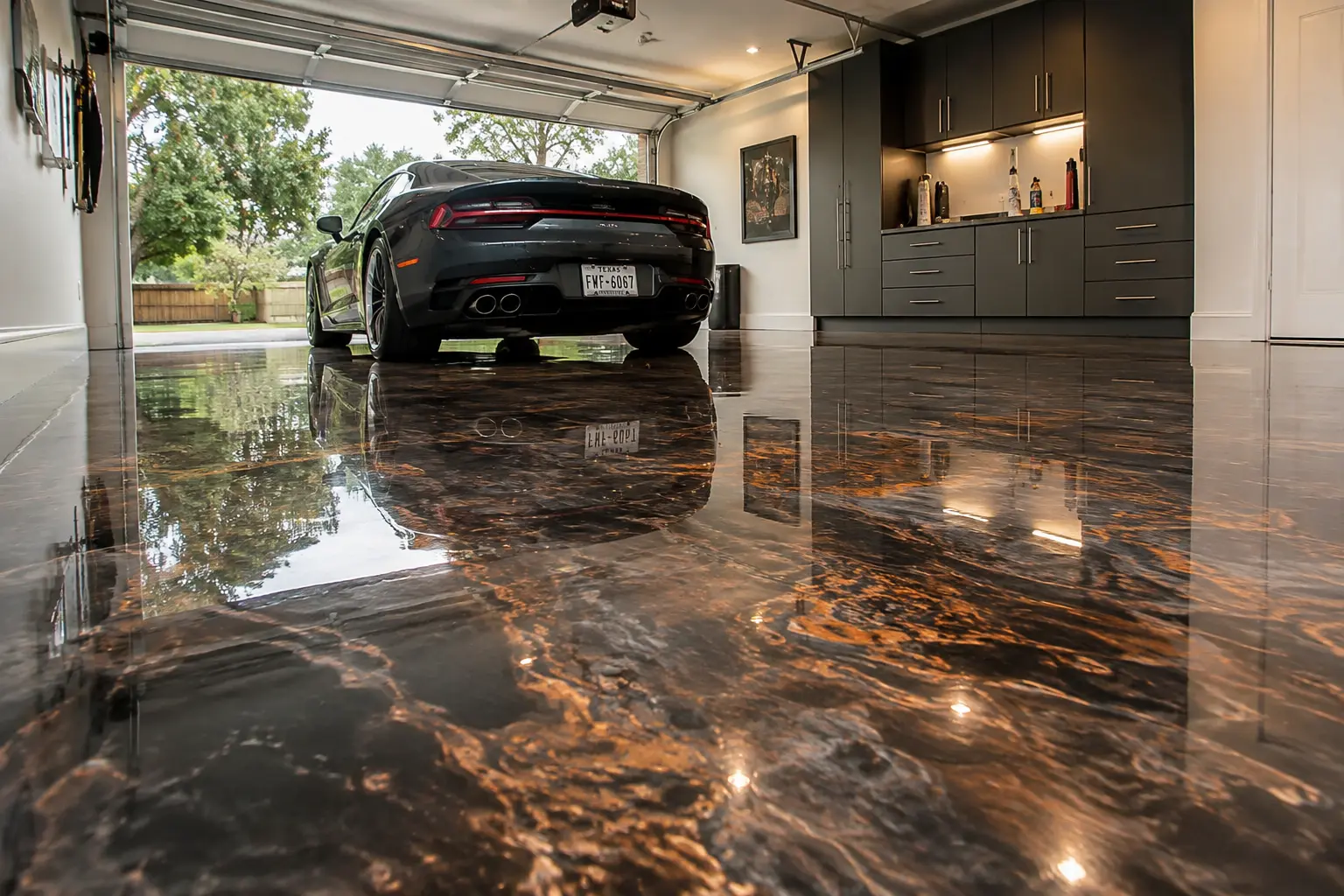
Systems get specified around how the floor is actually used and cleaned, not off a brochure, and we schedule around your operating hours so you are not shut down. Most commercial work runs $3 to $15 per square foot installed depending on the system and the shape of the slab.
Specify the system around the work, not the brochure
The single most expensive mistake in commercial flooring is putting the wrong chemistry in the wrong room. A warehouse aisle and a hot-line kitchen both get called an epoxy floor, and they should not get the same system.
|
Environment |
Typical system |
Installed cost |
|
Warehouse, storage, distribution |
High-build epoxy with urethane or polyaspartic topcoat |
$3 to $8 / sq ft |
|
Production, manufacturing, shop |
High-build epoxy, quartz broadcast where impact is heavy |
$5 to $10 / sq ft |
|
Auto and mechanic shops |
Chemical-resistant epoxy with polyaspartic topcoat |
$5 to $10 / sq ft |
|
Showroom, retail, office |
Decorative flake, metallic or polished look |
$5 to $12 / sq ft |
|
Commercial kitchen, food prep |
Urethane cement mortar with integral cove base |
$8 to $15 / sq ft |
|
Cold storage, washdown areas |
Urethane cement, thermal shock rated |
$8 to $16 / sq ft |
A quote coming in well under those ranges usually means thinner material, less prep, or both. Two contractors bidding the same warehouse can legitimately differ by 30 to 40 percent because of slab moisture, old coating removal, joint repair and scheduling constraints. Those are real scope items, not padding.
Where epoxy is the wrong choice
Worth saying plainly, because it is where a lot of commercial floors fail early and get blamed on the installer.
If your floor sees hot washdown, standard epoxy will not last. In a commercial kitchen or food plant, water coming off a hot line can hit 180 degrees while the slab underneath sits far cooler. That thermal differential exceeds what the epoxy-to-concrete bond can take, and the floor delaminates, often inside a year or two.
Most residential garages finish in a day. You can walk on it that evening and park on it the next morning.
Organic acids are the other thing that quietly destroys kitchen floors. Lactic, citric and acetic acid from everyday food production attack a resin matrix and soften it over time. Urethane cement handles that where epoxy struggles.
Dry storage, warehouse aisles, workshops, retail and showrooms are a different story. Epoxy is genuinely the right, cost-effective answer there, and that is most of what we install.
Compliance, in plain terms
If you run a kitchen or a food facility, a few things are worth knowing before anyone quotes you.
There is no such thing as an FDA approved floor. The FDA does not approve flooring products. What exists is FDA compliant, meaning the material meets the relevant food-contact requirements and the manufacturer can document it.
Compliance is about the installation as much as the product. A compliant floor is seamless and non-porous with no grout lines or cracks for bacteria to sit in, and it needs proper cove base where the floor meets the wall.
Which rules apply depends on what you are. USDA FSIS covers meat, poultry and egg facilities. FDA rules cover most other food manufacturers. Restaurants and foodservice generally answer to state and local health departments, which adopt their own version of the FDA Food Code.
We will tell you what the system meets and provide manufacturer documentation. What we will not do is claim a coating is approved by an agency that does not approve coatings.
Downtime, and how we work around it
For most commercial clients this matters more than the price per square foot, because a closed kitchen or a shut aisle costs real money.
Before we quote, we walk the space, moisture test the slab and ask how you actually clean the floor and what runs across it. Then you get a written scope with a schedule attached.
— Where it goes
Commercial Epoxy Flooring Austin: What We Install
Every environment on this list gets its own system, specified around your equipment, traffic and cleaning routine.

Warehouses & distribution
Storage and distribution floors, including forklift-rated systems and line striping for traffic lanes and safety markings.

Manufacturing & production
Chemical and impact resistance specified to what you actually handle on the floor.

Commercial kitchens
Kitchens, bars, breweries and food prep areas using seamless urethane cement with cove base.

Auto shops & dealerships
Service bays that need to shrug off oil, brake fluid and hot tires.
Retail & showrooms
Gyms, salons and offices too, where the floor is part of how the space looks.
Cold storage & washdown
Thermal shock rated systems for rooms that cycle between hot and cold.
— Where we work
Austin and the metro around it
From the Hill Country on the west side out to the eastern suburbs near the Tesla plant in Del Valle.
Neighborhoods: South and North Austin, East Austin, Circle C Ranch, Mueller, Westlake, Tarrytown, Hyde Park, Barton Hills, Steiner Ranch and Avery Ranch.
Zip codes include: 78704, 78745, 78748, 78749, 78759, 78717, 78660, 78681, 78613, 78641, 78626, 78620, 78738, 78610, and 78640.
— Good to know
Questions we get asked a lot
How much does commercial epoxy flooring cost in Austin?
Roughly $3 to $15 per square foot installed, depending entirely on the system. Warehouse epoxy sits at the low end, urethane cement for kitchens and washdown areas at the top. Slab condition, old coating removal and joint repair sit on top of the floor price as separate scope.
How long will we be shut down?
Usually less than you think, and often zero. We phase large spaces, work nights and weekends, and use fast-cure systems where reopening quickly matters. Kitchens are commonly done over a long weekend.
Is your flooring USDA compliant?
The systems we install for food environments are, when specified and installed correctly. That means seamless, non-porous, with integral cove base and manufacturer documentation to back it up. We will hand you the technical data sheets for your file.
Can you coat over our existing floor?
Sometimes, and we will not guess. If the existing coating is well bonded we can profile and go over it. If it is failing, it comes off first. Old coating removal is real work and we scope it separately rather than hiding it in the square foot price.
Will it hold up to forklifts?
Yes, with the right build. Forklift traffic needs a high-build system with the right thickness rather than a thin coating. We specify around your equipment and load.
Can you stripe traffic lanes and safety markings?
Yes. Line striping, aisle markings, safety zones and equipment outlines all go in as part of the job.
Do you work with property managers on multiple sites?
Yes. We handle multi-site and repeat work, and we can put together consistent specifications across locations so your floors match and the documentation is uniform.
— Where we work
Still deciding?
PERFORMANCE TOPCOAT
Polyaspartic coatings
The fast-cure, UV-stable chemistry we specify where reopening quickly matters.
DECORATIVE
Metallic epoxy flooring
Where appearance carries as much weight as durability, for showrooms and retail.
PRICING
Austin epoxy cost guide
Full breakdown across residential and commercial systems, plus what moves a quote.
— Get your facility assessed
Request a free site assessment
Tell us the square footage, what happens on the floor and how it gets cleaned. We will walk the space, test the slab and come back with a written scope, a schedule and a firm number.