
— The part cheap quotes skip
Concrete Floor Repair and Surface Prep in Austin, TX
Nobody hires us because they’re excited about surface prep. But it’s the part of the job that decides whether a floor coating lasts fifteen years or starts lifting next summer. We handle concrete floor repair Austin-wide: grinding, crack repair, and moisture testing, both as prep before our own coatings and as standalone work on slabs that need fixing before anything goes on top.
CSP 2–3
Ground profile, not acid-etched
Moisture Tested
Every slab, before we coat
Vacuum Collected
Grinding dust stays contained
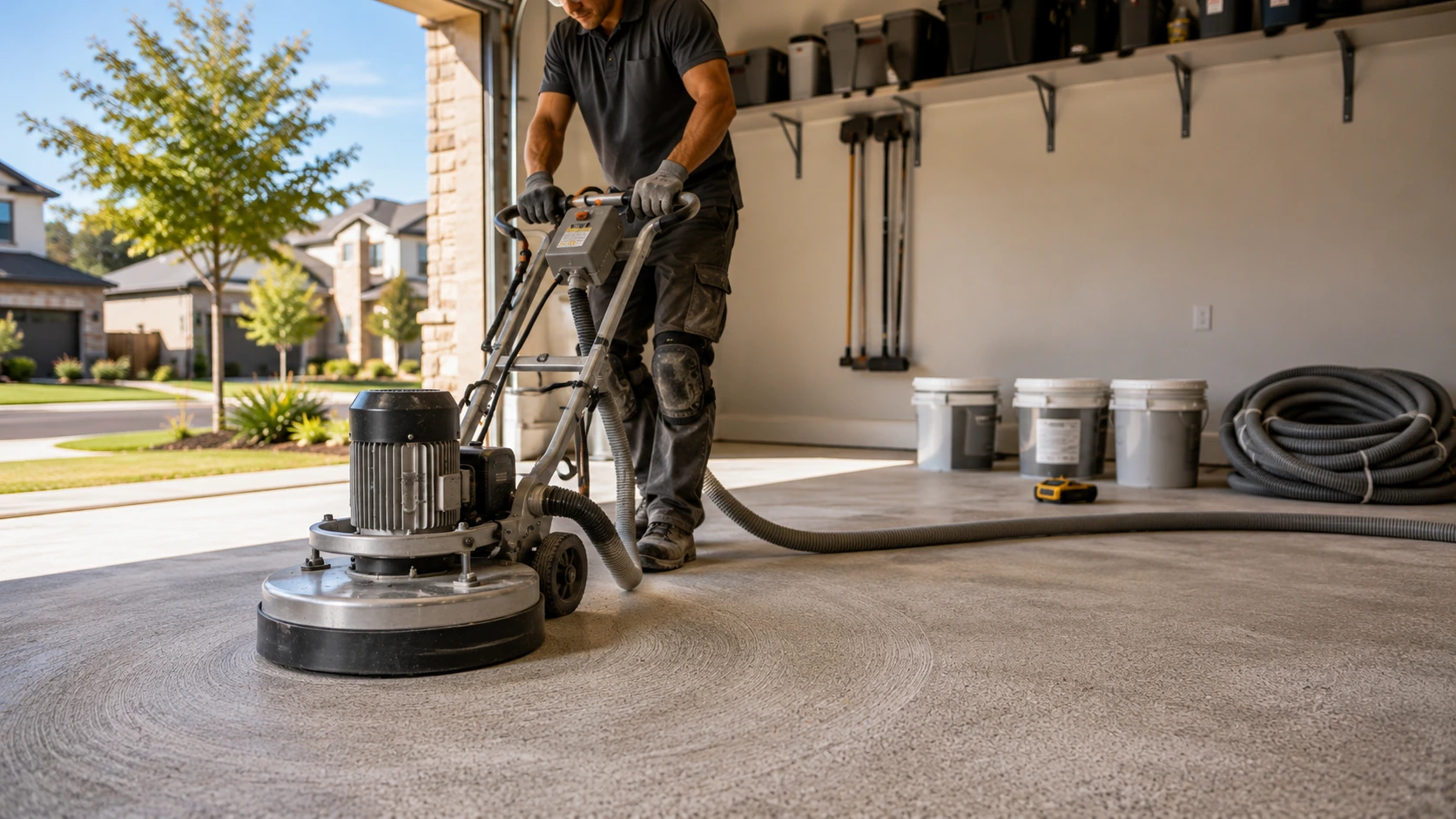
A coating does not glue itself to a smooth slab. It needs mechanical grip, and that comes from opening up the surface. Here’s why prep is the part of the job that actually decides how long a floor lasts.
Why Concrete Floor Repair Austin Prep Is the Whole Job
Fresh concrete has a weak, dusty top layer called laitance. It looks like part of the slab, and it is not. Coat straight over it and the coating bonds to that weak layer instead of to solid concrete, so the whole thing lets go later and takes the laitance with it.
Grinding removes it and opens the concrete to a profile of roughly CSP 2 to 3, which feels about like medium-grit sandpaper. That texture is what a coating actually keys into. It’s a measurable standard, not a judgement call, and it’s why we don’t use acid etching. Acid cleans a floor. It does not create profile, and it leaves residue behind that has to be neutralized and rinsed.
What we do before any coating goes down

Diamond grinding
Planetary grinders with vacuum dust collection attached. That keeps the dust out of your house or your inventory, and it gets the profile right across the whole slab, including the edges and corners where cheap jobs get lazy.

Crack and joint repair
Cracks get opened up and filled with flexible polyurea joint filler rather than a rigid patch. Rigid material cracks the first time the slab moves, and here it will move. Control joints are a separate conversation, and we’ll tell you which we would do.

Spall and pit repair
Chipped, pitted, and spalled areas get rebuilt with epoxy mortar and levelled back flush. Old anchor holes, chipped edges by the garage door, and popped aggregate all get dealt with here.

Oil and contamination removal
Oil that has soaked into concrete will stop a coating from bonding no matter how well you grind. Stains get degreased and, where it has gone deep, ground out or treated before we go any further.

Moisture testing
This is the step almost nobody else mentions. Water vapor moving up through a slab will push a coating off from underneath, sometimes weeks after it looked perfect. We test before coating, and if the readings are high, we use a vapor barrier primer rather than pretending we didn’t see it.
Why Austin slabs need more of this than most
Two local things make prep a bigger deal here than it would be somewhere milder.
Expansive clay
Central Texas sits on black gumbo clay that swells when it rains and shrinks back in drought. That cycle moves foundations and cracks slabs right across Travis, Williamson, and Hays counties. It’s why we use flexible fillers instead of rigid patches, and why a coating with some give outlasts a brittle one here.
New construction
The suburbs are full of slabs that are only a year or two old. Fresh concrete holds a lot of moisture, and coating it too early is a common cause of early failure. We check age and moisture before committing to a schedule.
Standalone repair work
Not everything we do here ends in a coating. If you’re not sure whether your slab needs repair or replacement, we’ll tell you honestly. Surface damage is fixable. Structural movement usually is not, and coating over a structural problem just hides it for a while.
— No coating required
Standalone repair work
Plenty of slabs just need fixing, no finish coat involved.

Failed coating removal
DIY kits that have started peeling and older epoxy that has lost its bond.

Crack & spall repair
Garage floors, patios and warehouse slabs that just need fixing.

Grinding for other trades
Grinding and profiling if someone else is installing the finish floor.

High spots & old adhesive
Grinding down trip hazards and old adhesive or thinset from removed tile.
— Where we work
Austin and the metro around it
From the Hill Country on the west side out to the eastern suburbs near the Tesla plant in Del Valle.
Neighborhoods: South and North Austin, East Austin, Circle C Ranch, Mueller, Westlake, Tarrytown, Hyde Park, Barton Hills, Steiner Ranch and Avery Ranch.
Zip codes include: 78704, 78745, 78748, 78749, 78759, 78717, 78660, 78681, 78613, 78641, 78626, 78620, 78738, 78610, and 78640.
— Good to know
Questions we get asked a lot
Why can’t you just paint or coat over my existing floor?
Because whatever is on the surface is what the new coating bonds to. If that is dust, laitance, oil or a failing old coating, the new floor inherits the problem. Grinding gets you down to sound concrete with a real profile.
Is acid etching good enough?
No, and we don’t use it. Acid cleans concrete but does not create the mechanical profile a coating needs, and it leaves residue that has to be fully neutralized. Mechanical grinding is the standard for a reason.
How messy is grinding?
Far less than people expect. Our grinders run with vacuum dust collection, so it is not the cloud of concrete dust you are picturing. We also mask off walls, doorways and anything nearby.
Can you fix cracks permanently?
We can fill them so they stay filled and stop telegraphing through the finish. What no one can do is stop a slab moving. That is why flexible polyurea filler matters. It moves with the crack rather than snapping the first time the ground shifts.
What is moisture testing and do I need it?
It measures how much water vapor is coming up through the slab. You need it because high vapor transmission will delaminate a coating from below regardless of how good the product is. It is a short test and it prevents the most expensive kind of failure.
My garage floor is badly spalled. Is it too far gone?
Usually not. Spalling, pitting, and surface damage are exactly what repair and resurfacing handle. Structural cracking with real movement is a different problem, and if that is what you have, we will say so instead of coating over it.
Do you remove old epoxy or DIY kits?
Yes, that is a regular job for us. Failed kits usually come off entirely rather than getting coated over, and we scope removal separately so you can see what it costs.
— Where we work
Still deciding?
CORE SERVICE
Epoxy garage floor coating Austin
The full flake system we build on top of the prep work described here.
COMPARISON
Epoxy vs polyaspartic
Cost, lifespan, UV resistance, cure time, and which one suits the Texas climate.
B2B
Commercial & warehouse epoxy
Where the same grinding and moisture-testing standard applies at scale.
— Get your slab looked at
Get a free repair & prep assessment
Send a couple of photos or have us come out. We will tell you what the concrete actually needs, whether that is repair, a full coating system, or in some cases nothing at all yet.