
— Our core service
Garage Flooring in Austin: 6 Options Compared
If you are comparing garage flooring Austin contractors actually install, there are six real options, and only three of them hold up well in Texas heat. Here is the honest version of each, including the ones we do not sell.
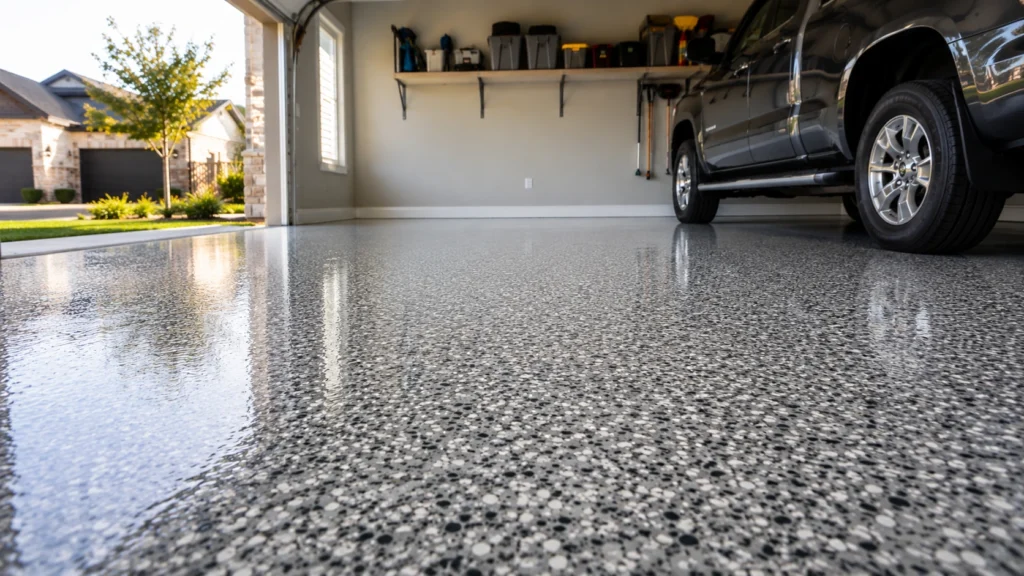
Coatings like epoxy and polyaspartic last 10 to 20 years and cost $4 to $12 per square foot installed. Tiles and mats are cheaper and you can lay them yourself, but they trap moisture. Garage floor paint is the cheapest, and it is also the one we spend most of our time removing.
Below is what each option costs, how long it lasts, and what our climate does to it.
Garage flooring options in Austin at a glance
Start here, then read the details on whichever two or three are still in the running.
|
Option |
Cost / sq ft |
Lifespan |
Handles Texas heat |
DIY? |
|
Garage floor paint |
$0.50 to $2 |
1 to 3 yrs |
Poor |
Yes |
|
Roll-out mats |
$1.50 to $4 |
3 to 8 yrs |
Fair |
Yes |
|
Interlocking tiles |
$3 to $8 |
5 to 15 yrs |
Fair |
Yes |
|
Solid-color epoxy |
$4 to $7 |
5 to 10 yrs |
Good |
Not really |
|
Full flake epoxy |
$5 to $9 |
10 to 15 yrs |
Very good |
No |
|
Polyaspartic |
$6 to $12 |
15 to 20 yrs |
Excellent |
No |
1. Garage floor paint, the one to skip
Cost: $0.50 to $2 per square foot. Lifespan: one to three years.
This is the one-part latex or acrylic stuff sold in buckets at the big-box stores, often labelled epoxy paint. That name causes most of the confusion on this list. It is not epoxy. It is fortified paint with a small amount of epoxy in it, and it goes on with a roller straight onto the slab.
It is cheap, and it looks fine for a season. Then a hot Austin July arrives, the coating softens, and the first time you pull a warm car in, the tires lift it off in strips. That is hot tire pickup, and it is the single most common failure we get called out to fix.
Verdict: skip it unless you’re selling the house within a year.
2. Roll-out garage mats
Cost: $1.50 to $4 per square foot. Lifespan: three to eight years.
Heavy PVC or vinyl matting you unroll across the slab. No prep, no cure time, and you can do the whole garage in an afternoon. It also comes back up when you move, which is why renters like it.
The problem in our climate is underneath. Moisture that comes up through a slab, and it does here, gets trapped under the mat instead of evaporating. Lift a two-year-old mat in a humid Austin garage and you often find mildew and staining on the concrete. Cheaper PVC also off-gasses in heat, which is the smell people describe in a closed garage in August.
Verdict: fine for a rental or workshop bay. Check under it a few times a year.
3. Interlocking garage floor tiles
Cost: $3 to $8 per square foot. Lifespan: five to fifteen years.
Rigid polypropylene or flexible PVC squares that snap together like a puzzle. They tolerate an uneven or cracked slab better than any coating, because they float on top rather than bonding to it. If one gets damaged, you pop that tile out and drop a new one in.
Two catches. First, the same trapped-moisture issue as mats, though ventilated designs handle it better. Second, seams. Every joint is a place for dust, sawdust and spilled oil to work down into, and no amount of sweeping gets it all back out.
Verdict: the best non-coating choice for a damaged slab you’re not ready to repair.
4. Solid-color epoxy coating
Cost: $4 to $7 per square foot. Lifespan: five to ten years.
Now we are into real coatings, which bond into the concrete rather than sitting on it. A two-part epoxy is mixed on site, goes down over a ground and profiled slab, and cures into a hard, seamless surface with no seams and nothing to trap moisture underneath.
Solid color is the entry point. One clean color, no flake, no pattern. It stops the concrete dusting and it wipes clean. What it does not do is hide anything. Every scuff, tire mark and drip shows on a plain surface.
Verdict: good value for a storage garage on a budget.
5. Full flake epoxy, what most Austin homeowners pick
Cost: $5 to $9 per square foot. Lifespan: ten to fifteen years.
Same epoxy base, but vinyl chips get broadcast across the wet coating until the floor will not take any more, then the whole thing is sealed under a clear topcoat. The chips add texture so the floor is not slick; they hide dust and tire marks far better than a plain surface, and they give you a colour blend you can match to the house.
This is what we install more than anything else, and for most Austin garages it is the right answer. It handles daily driving, dropped tools and summer heat, and it still looks presentable when the door is open.
Verdict: the best balance of cost, durability, and appearance. See our epoxy garage floor coating page.
6. Polyaspartic coating, the one built for Texas sun
Cost: $6 to $12 per square foot. Lifespan: fifteen to twenty years.
Polyaspartic is a polyurea-based coating and the most durable option on this list. Three things separate it from epoxy. It stays flexible, so it moves with a slab instead of cracking with it. It is UV-stable, so it does not amber in sunlight the way standard epoxy does. And it cures in hours rather than days, which is how a full garage gets done in one day.
It costs more, so most floors we install use an epoxy base with a polyaspartic clear coat on top. You get the UV and heat performance where it matters, at less than the price of a full polyaspartic system. See our polyaspartic coatings page and the epoxy vs polyaspartic comparison.
Verdict: worth the premium for a west-facing garage that bakes all afternoon.
Which garage flooring suits an Austin garage?
Three local things narrow this list faster than anything else.

Heat
A closed garage here can pass 120 degrees in July. That rules out garage floor paint and makes cheap epoxy risky.

Slab movement
Central Texas sits on expansive clay that swells with rain and shrinks in drought, cracking slabs across Travis, Williamson, and Hays counties.

Slab age
In newer suburbs like Leander, Georgetown, and Buda, a slab may still be releasing moisture. We moisture-test before quoting rather than after.
Short answer: flake epoxy for most garages, polyaspartic if it gets heavy sun, interlocking tiles if the slab is too damaged to coat right now, and paint for nobody.
What garage flooring in Austin costs by garage size
Per-square-foot numbers are hard to picture, so here is the same information as real garages.
|
Garage size |
Approx. sq ft |
Tiles or mats |
Flake epoxy |
Polyaspartic |
|
1-car |
240 to 300 |
$500 to $2,000 |
$1,300 to $2,500 |
$1,600 to $3,400 |
|
2-car |
400 to 500 |
$800 to $3,500 |
$2,200 to $4,200 |
$2,700 to $5,700 |
|
3-car |
600 to 750 |
$1,200 to $5,500 |
$3,300 to $6,300 |
$4,000 to $8,500 |
Those are installed ranges for coatings and material-only ranges for tiles and mats, since most people fit those themselves. Slab condition moves the coating numbers more than anything else see our full cost breakdown.
— Where we work
Austin and the metro around it
Garage flooring installed across Travis, Williamson and Hays counties.
— Good to know
Garage flooring Austin FAQs
What is the best garage flooring for Austin heat?
Polyaspartic, with flake epoxy a close second. Both handle a garage that passes 120 degrees in summer. Polyaspartic also resists UV, so it won’t yellow where sun comes through an open door. Garage floor paint is the worst choice because it softens and lifts with hot tires.
How much does garage flooring in Austin cost?
Between $0.50 and $12 per square foot depending on what you choose. For a typical 2-car garage that’s roughly $800 to $3,500 for tiles or mats you fit yourself, and $2,200 to $5,700 for a professionally installed coating.
Are garage floor tiles better than epoxy?
Only in specific situations. Tiles win if your slab is cracked or damaged and you’re not ready to repair it, or if you rent. Epoxy wins on lifespan, on having no seams to trap dirt, and on not trapping moisture against the concrete.
Can I install garage flooring myself?
Tiles and mats, yes. Coatings, realistically no. Coatings need mechanical grinding, moisture testing and a working knowledge of pot life. Polyaspartic sets in about thirty minutes, which leaves no room to learn on the job.
How long does garage flooring last in Austin?
One to three years for paint, three to eight for mats, five to fifteen for tiles, and ten to twenty for a properly installed coating. The gap between a DIY kit and a professionally ground and coated floor is bigger here than in milder climates, because our heat punishes weak bonds.
What is hot tire pickup?
It’s when hot tires lift the coating off the slab as you park. It happens when a coating softens in heat or never properly bonded to begin with. Diamond grinding and a heat-rated topcoat are what prevent it.
Do you install garage flooring outside Austin?
Yes, across the metro, including Round Rock, Cedar Park, Leander, Georgetown, Pflugerville, Hutto, Manor, Buda, Kyle, Dripping Springs, Lakeway and Bee Cave.
— Get help choosing
Get a free estimate for your garage
Tell us how you use the garage and what shape the slab is in. We’ll come out, measure, moisture-test and give you a firm written number. If tiles are genuinely the better call, we’ll tell you that too.