
— Head-to-head comparison
Epoxy vs Polyaspartic: Which One Does Your Garage Need?
Both are good coatings. The honest answer isn’t “polyaspartic is better”; it’s which one matches what your floor actually has to survive, and in Austin, that survival test is heat, sun, and a slab that moves.
$3–12
Most installs
$5–15
Written warranty
5–20 Yrs
Typical 2-car garage
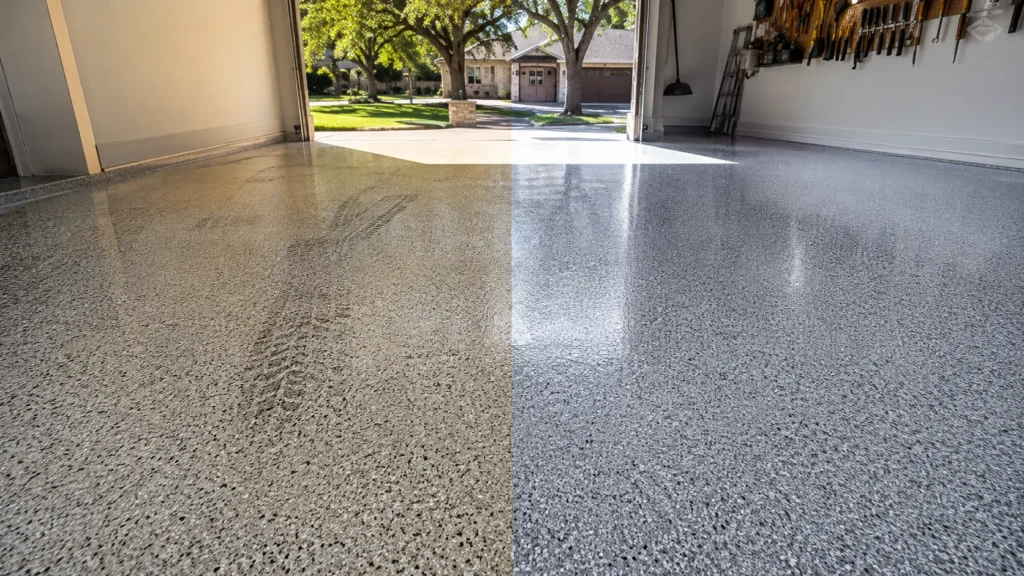
If you want a specific decorative effect, that steers the choice on its own. Metallic finishes are built in epoxy, because the pigments need the resin body and the longer working time to be manipulated properly. In cases like that, the extra spend on a full polyaspartic system buys you less than it costs.
Which one suits a hot climate?
Polyaspartic, clearly — and this is where the theory stops being theoretical. We install these floors in Austin, Texas, where a closed garage can pass 120 degrees in July and afternoon sun comes straight through an open door.
What we see in this climate is consistent. Cheap epoxy floors soften in summer heat and lift at the tire tracks. Light coloured epoxy exposed to sun goes amber within a season or two. And Central Texas sits on expansive clay that swells and shrinks through every drought and downpour cycle, which cracks slabs and takes rigid coatings with them.
So nearly every floor we put down here finishes with a polyaspartic topcoat, regardless of what is underneath it. In a mild, shaded, stable climate, that call would be different. Which is really the honest answer to the whole question: the right coating depends on what your floor has to survive.
Based in Austin and want a straight recommendation for your garage? Get a free on-site estimate →
For the full cost breakdown by size and finish, see our Austin epoxy garage floor cost guide, or compare systems on our garage flooring options page.
— Straight pricing
How much more does polyaspartic cost?
Roughly 30–50% more
Epoxy runs $3 to $12 per square foot installed and polyaspartic runs $5 to $15. Adding a polyaspartic topcoat to an epoxy base costs far less than a full polyaspartic system and captures most of the benefit — which is why it’s the system we quote most often.
Epoxy system
Standard 2-car garage
$3 to $12 / sq ft
$3 to $12 / sq ft
Topcoat or full build
$5 to $15 / sq ft
— Good to know
Epoxy vs polyaspartic FAQs
Is polyaspartic better than epoxy?
For most garages, yes, on performance. It lasts longer, resists UV and heat, and cures in hours. Epoxy is cheaper and builds a thicker film, so the usual professional answer is to use both epoxy underneath and polyaspartic on top.
Can polyaspartic be applied over epoxy?
Yes, and it is the standard way to build a floor. An epoxy base with a polyaspartic clear coat is the most common professional system. Over an existing cured epoxy floor it can also work, provided the old coating is still well bonded and gets mechanically abraded first.
How much more expensive is polyaspartic?
Roughly 30 to 50 percent more than a comparable epoxy floor. Epoxy runs $3 to $12 per square foot installed and polyaspartic $5 to $15. Adding a polyaspartic topcoat to an epoxy base costs far less than a full polyaspartic system and captures most of the benefit.
Does polyaspartic yellow in the sun?
No, and that is its defining advantage. Polyaspartic is aliphatic, so ultraviolet light does not break it down. Standard epoxy is aromatic and will amber over time in direct sunlight.
Can I install polyaspartic myself?
Realistically no. Pot life is 20 to 40 minutes and shorter in heat. Once it is mixed, there is no pause button. Epoxy is more forgiving but still needs mechanical grinding and moisture testing to work properly.
How long does each coating last?
Epoxy 5 to 10 years; polyaspartic 15 to 20. Both figures assume proper diamond-ground preparation. Without it, neither number holds, and prep failures cause far more early problems than product choice ever does.
Which is more slip-resistant?
Neither, on its own. Both are smooth when cured. Slip resistance comes from what is added — decorative flake for texture or an aluminium oxide additive broadcast into the topcoat.
Is polyaspartic the same as polyurea?
Polyaspartic is a type of polyurea. Specifically, an aliphatic polyurea with a slower, more controllable reaction, which is what makes it workable as a floor coating. Standard polyurea sets far too fast to spread by hand.
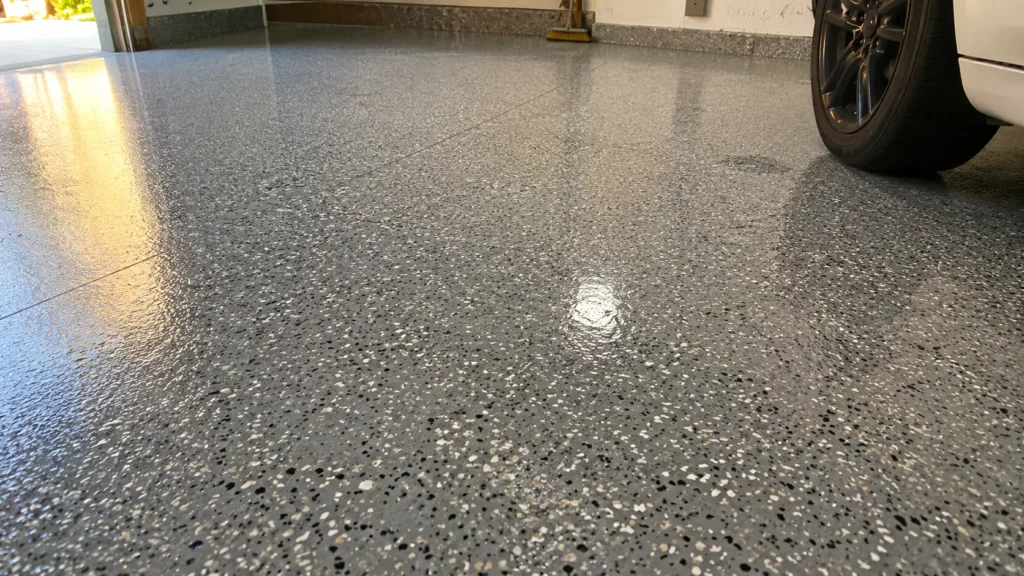
If you are choosing one: polyaspartic, unless the space is shaded, indoors, and low traffic, in which case epoxy will serve you fine for less money.
If you are choosing a system, which is what you are really doing: an epoxy base with a polyaspartic topcoat is the right specification for most garages, and it is what a good contractor will quote you without being asked.
And whichever you pick, the preparation underneath matters more than the choice itself. A properly ground slab under a mid-range coating outlasts a premium coating over a dirty one every single time.
— Where we work
Still deciding?
CORE SERVICE
Polyaspartic coatings in Austin
Why we finish nearly every floor here with a polyaspartic topcoat, and what that install day looks like.
PRICING
Austin epoxy garage floor cost guide
Full breakdown by size and finish, plus what pushes a quote up or down.
OPTIONS
Garage flooring options page
Flake, metallic, solid colour, and polyaspartic clear: how each finish is built.
— Get a floor built for the heat
Get a free on-site estimate
Tell us about the garage, how much sun it gets, and what shape the slab is in. We’ll come measure, moisture test, and give you a firm written number, with no pressure attached.